Jheelum Sarkar

Job Market Paper

Other Working Papers

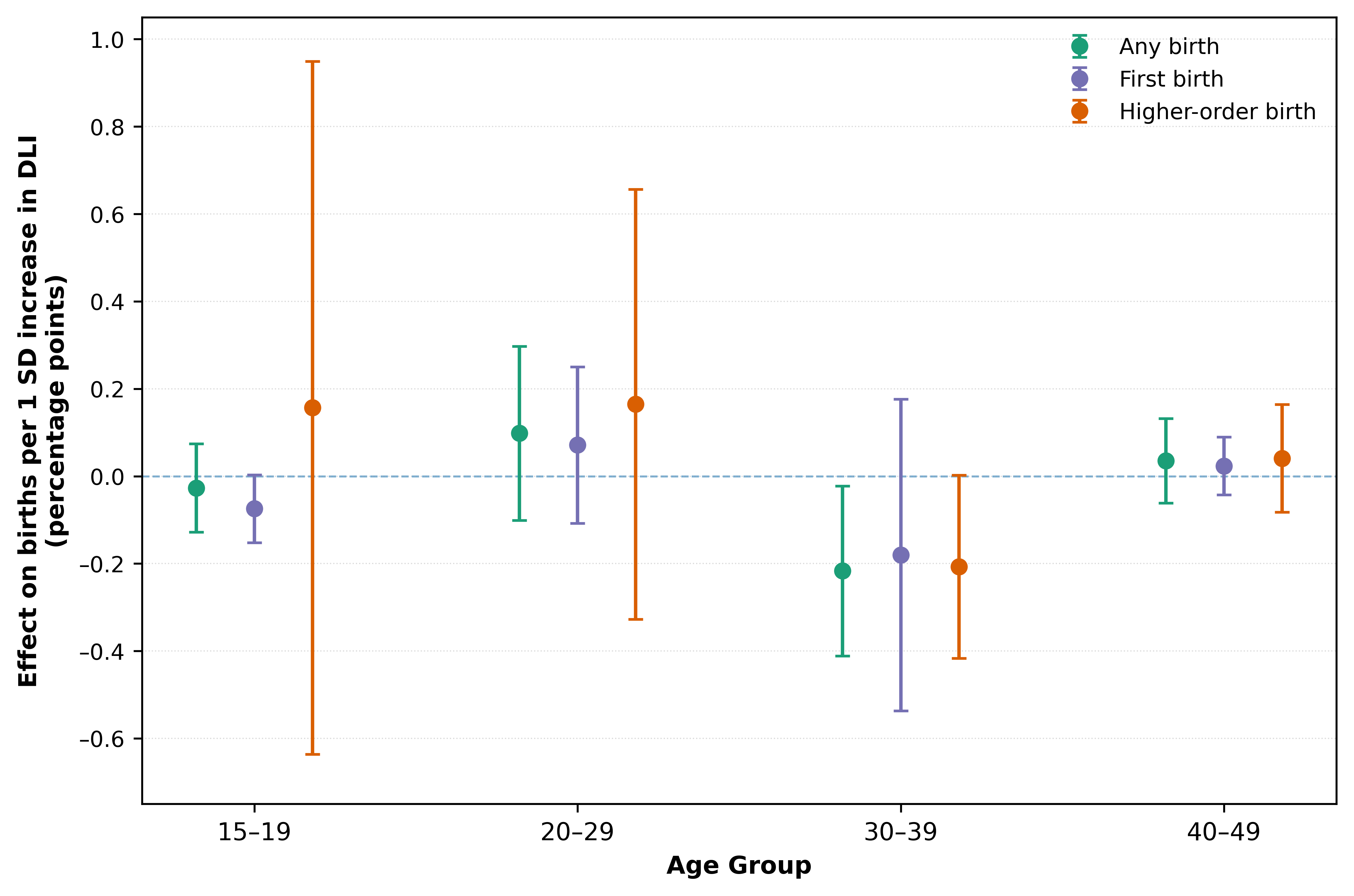
Remote Work and Fertility Outcomes figure for women aged 15 to 44 in the United States

Can remote work be an antidote to declining U.S. fertility rates?

Read abstract

I study how exposure to remote work affects fertility outcomes in the United States. Exploiting variation in occupation-level remote-work potential and combining 2016-2023 data from the Current Population Survey, I estimate dynamic difference-in-differences models that compare fertility changes among women in occupations with higher versus lower remote-work potential before and after the COVID-19 shock. For every one-standard-deviation increase in remote-work potential, women experienced nearly 0.5 additional births per 1,000 women during the pandemic and 0.3 additional births per 1,000 women in the post-pandemic period. Decomposing fertility by birth order, I find positive effects for both first births and higher-order births during the pandemic: first births rise by about 0.4 births per 1,000 women, while higher-order births rise by about 0.5 births per 1,000 women. In the post-COVID period, higher-order birth estimates remain positive, at about 0.4 births per 1,000 women, but are less precisely estimated. The effects are concentrated among women in prime childbearing ages, especially ages 25-34, and are stronger among women with college education and above-median income. Key estimates remain robust across alternative remote work measurements. These results suggest that remote work can relax trade-offs between career and family formation, but the gains from flexibility are unequal across socioeconomic groups.

Email for the latest draft.

Since the financial crisis in 2007, the United States has experienced a historic decline in fertility by 25% to 1.64 in 2020, which is well below the replacement level. While part of this decline reflects a sharp fall in teen births, college-educated women also have fewer children by 31%. Among highly educated women, childbirth often conflicts with jobs that impose high time demands and make it costly to combine career advancement with caregiving. In this paper, I examine whether remote work can relax this career-family trade-off. Remote work increases workplace flexibility and makes it easier to coordinate between paid jobs and family responsibilities. Since the COVID-19 pandemic, remote work has become a mainstream working arrangement. Using 2016-2023 Current Population Survey data and remote work potential across occupations, I study whether women in occupations with greater remote-work potential experienced different fertility responses during and after the COVID-19 shock, especially those in prime working and childbearing ages.

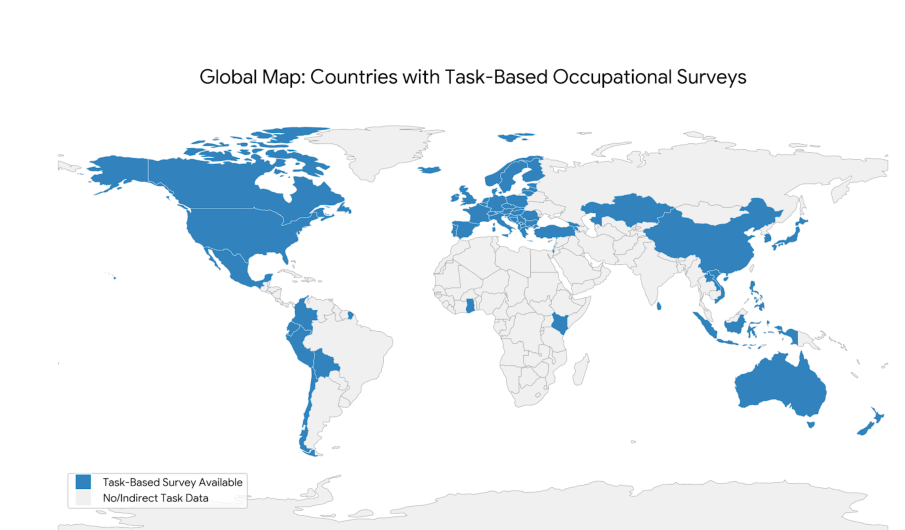
Global map showing countries with task-based occupational surveys

How many jobs are teleworkable in emerging economies?

Read abstract

Several developing countries lack task-based surveys at detailed occupation levels. This paper develops new occupation-level telework scores for emerging economies, where the non-pecuniary cost of working outside is very high for women. Using the textual descriptions of 3,448 detailed occupations in the Indian occupation manual, I train a supervised text classifier to estimate a telework score for each occupation. I find that 36.6% of occupations have moderate to high telework potential. Software engineering, product design, management, and research-based occupations exhibit the highest telework potential, while physically intensive occupations such as machine operators and construction workers rank the lowest. This ranking remains consistent with alternative measures derived from large language model (LLM) analysis. Extending the methodology to two other large emerging economies, namely Brazil and China, I find similar occupations ranking at the top and bottom of the distribution. Applying this occupational classification to 96 other countries, I find that teleworkable jobs are concentrated in countries with higher urbanization, internet connectivity, and income per capita. These findings demonstrate that occupation manuals can substitute for task-based surveys in measuring telework potential, an important input for studying the implications of telework shaping labor markets in emerging economies.

Email for the latest draft.

How can we study remote work implications in emerging economies where detailed task surveys like O*NET do not exist? This paper shows that national occupation manuals can fill this measurement gap. Using textual descriptions of 3,448 detailed occupations in India, I train a supervised text classifier to construct occupation-level telework scores and validate the rankings against LLM-based measures. Nearly 36% of occupations have high telework potential. The ranking is intuitive and robust: software, design, management, and research jobs score highest, while construction, machine operation, and other physically intensive jobs score lowest. Extending the approach to Brazil, China, and 96 other countries, the paper shows that teleworkable jobs are disproportionately concentrated in economies that are richer, more urbanized, and more digitally connected.

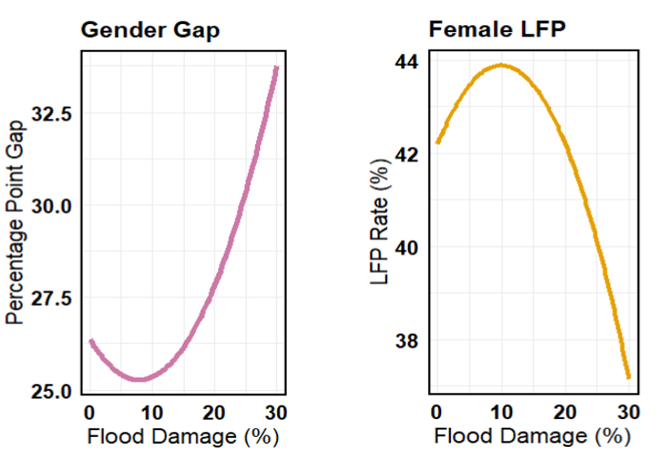
Nonlinear drought and wet intensity effects on the gender gap in labor force participation

Droughts and Deluges: Nonlinear Effects of Climate Extremes on the Gender Gap in Labor Supply.

Why does existing evidence disagree on whether climate shocks widen or narrow gender gaps in paid work? This paper argues that the answer lies in nonlinear responses. Using a collective bargaining framework and a panel of 151 countries from 1995 to 2019, I show that droughts and extreme wet conditions have different, nonlinear relationships with the gender gap in labor force participation. Droughts exhibit a U-shaped relationship with gender gaps, mainly through employment, while extreme wet conditions exhibit an inverted U-shaped relationship, mainly through unemployment. These patterns are strongest in countries with weaker climate resilience, lower or moderate women’s empowerment, and greater disaster-displacement risk. The findings provide a general cross-country framework for understanding why climate shocks generate mixed gendered labor-market effects across settings.

Read abstract

Over the past three decades, extreme climate events have caused losses of worth USD 4.5 trillion. Using collective bargaining model, I find that the gendered labour supply response to adverse shocks is not straightforward since it depends on relative strength of income and substitution effects of men's and women's participation. Using a panel of 151 countries (1995-2019), I examine how extreme climate conditions shape gender gap in labour force participation. This study finds that the gender gap in paid labour exhibits a U-shaped relationship with droughts and an inverted U-shaped relationship with extreme wet conditions. The drought pattern is primarily driven by gender gap in employment while wetness affects gender gap in participation through unemployment. These relationships vary with country characteristics. Countries with high disaster-displacement risk exhibit declining gender gaps in participation during excess wetness while moderate-risk economies experience expanded gaps during droughts. Furthermore, the drought U-shape is most pronounced in countries with low to moderate empowerment while the nonlinear wet responses is concentrated only in moderately empowered countries. Lastly, both droughts and excess wetness expands gender gap in countries with weak net resilience to climate shocks.

arXiv: 2602.07808
Event-study figure for weekly working hours after an Indian coastal flood shock

Who gets hit first and who recovers last? Evidence from Indian coastal flood shock.

How do catastrophic floods reshape men’s and women’s paid work differently? This paper examines the 2018 Kerala flood, a 1-in-100-year event in coastal India, by combining satellite-derived flood exposure with quarterly labor force data. I find that men are hit first: their employment falls immediately after the flood but recovers quickly. Women, by contrast, recover last: their paid working hours decline with a delay and remain depressed for longer. The gender gap in recovery reflects sectoral exposure and household constraints. Men’s losses are concentrated in the secondary sector, while women are hit hardest in tertiary-sector work, likely because service jobs depend on restored infrastructure and workplace access. Marital status and dependency burden further amplify these gendered effects. The paper shows that disaster recovery is not gender-neutral: even when men face the first employment shock, women may bear the longer labor-market cost.

Read abstract

Catastrophic floods directly risk 1.8 billion lives worldwide, most of whom are from East and South Asia. How do extreme floods reshape paid labor outcomes? To answer this, I focus on a 1-in-100 year flood event in India. I first combine Sentinel-1 SAR with JRC Global Surface Water dataset to generate flood map. Using information from this map in various rounds of periodic labor force surveys, I estimate gender-specific dynamic effects of the flood shock. Key results show that men experienced short-lived reduction in their employment while women faced a delayed but persistent decline in their working hours. Men suffered most in secondary sector and increased their participation in primary sector. Women were hit hardest in the tertiary sector. Such sectoral impacts could be attributable to disruptions in infrastructure and physical capital. Moreover, marital status and dependency burden further shape the gender differential effects of the extreme flood event. Results remain robust under alternative treatment definitions.

arXiv: 2510.08856
Historical emissions, temperature anomaly, and inequality figures for the climate inequality review essay

Linking Climate Change with Economic Inequality: A Review Essay.

This review essay synthesizes how climate change interacts with inequality across and within countries. It highlights the central role of gender, occupation, and adaptive capacity in shaping who bears the costs of climate shocks.

Read abstract

This article examines the complex relationship between climate change and economic inequality, exploring both cross-country and within-country scenarios. Changes in average temperatures and precipitations are identified as significant contributors to cross-country inequalities. Several studies have also employed greenhouse gas (GHG) emissions, particularly carbon dioxide emissions, as an indicator of global warming. These studies show that the relationship between cross-country inequality and global warming is mixed and primarily depends on the pre-existing income levels of the countries being compared. The sudden onset of climate events exacerbates economic inequalities within a country. However, the extent of this impact varies depending on the adaptive capacities, occupation, and gender of individuals dwelling in the affected regions. In the case of within-country scenarios, gender emerges as a pivotal factor in the climate-inequality nexus, influencing labor division and accessibility to social infrastructure. This review highlights the multifaceted nature of the climate-inequality nexus and emphasizes the importance of incorporating both economic and social factors to inform effective policy interventions.

SSRN: 4814257

Work in Progress

  • Remote Work, AI and Women's Employment
  • Impact of Telework on Wage Inequality in United States
  • Environmental Justice and Enforcement of Pollution Standards in the United States (with Dr. Phuong Ho, Dr. Bianca Cecato, and Dr. Almira Salimgarieva)

Publications

  • Sultana, N., Sarkar, J., & Meurs, M. (2024). Climate Change-Induced Migration: A Gendered Conceptual Framework. Migration and Diversity, 3(2), 215-233. https://doi.org/10.33182/md.v3i2.3177